Start with what Dell did under coercion. Then open the emails, the body under load, the OCR closeout,
and only then the national pattern. Outrage first. Pattern second. That is the design.
Chapter 01
The foundation of truth
APA ethics require voluntary informed consent for evaluation. A process begun under a financial ultimatum —
attend or lose support — is not a free clinical choice. Call it what it is:
involuntary / coerced consent.
That is the foundation. Every diagnosis stamp, every score label, every “above average” rewrite of a
Superior classification sits on top of a cracked base. If the consent is void, the permanent record
is not neutral science. It is power with letterhead.
Contested labels in a cold file are not the story to feed an audience. The story is pressure,
what you already put on the record in good faith, and what the institution did with power.
Before the report, there was volume: long letters, labs, videos, mind-body history, nervous-system cost,
“I did not feel another eval was necessary.” Shorter messages had not produced shared understanding for years.
Length was not pathology. Length was careful translation after not being heard.
The public extract is 467 messages in strict chronological order (Nov 2024 → May 2025),
roles only — Mom, Dad, Sister, BIL, Dell staff. Attachments (labs, letters, video) often traveled with
those messages; a text export is the spine, not the whole body.
If you doubt the volume, do not take a summary on faith. Scroll the chronology.
Mid-evaluation, while the patient was writing hard truths about nervous-system cost, mind-body recovery,
and pressure on consent, logistics with Dell administration also moved on a family–clinic thread
(including a sister-role subject line, with parents on copy). The patient received a
forward the same day — after the institutional conversation was already underway —
rather than as a co-equal author of every step.
Families under strain often “handle” medical systems the way they know how: calling, emailing, advocating.
That can come from care. It can still leave the patient outside the room where decisions form.
Institutions have a duty not to build a permanent record on a split process. When content is hard,
systems sometimes route around the speaker instead of integrating what they said.
That is named here as process failure — not as proof that no one loved him.
The evaluation path was not a gentle “please consider a second opinion.” A personal connection on the
Dell Medical Advisory Board helped open the door; support was then conditioned on attending —
attend, or lose financial and medical support.
Whatever mix of fear, love, frustration, and hope sat behind that condition, the structure itself matters:
it is the mechanism that turned a research-informed conversation about stress and illness into a
high-stakes clinical stamp. Adding evaluation pressure while the patient was naming stress biology
is a systems irony — not a claim that anyone set out to be cruel. Dell’s duty was to refuse or redesign
a process that could not be freely chosen.
Under infection, mold load, and process stress, the patient still scored in the
97th percentile of abstract perceptual reasoning — standardized Superior —
then watched narrative language pull the result toward “above average” to fit a story.
Objective labs of active tick-borne disease were minimized. Secret family input was solicited; existence
of the letter later denied. All of it committed to a permanent medical record that follows housing,
disability, trust, and care for years.
A permanent record is not a conversation. It is a stamp. Stamps need more honesty than power usually offers.
Process stress is not a slogan. The body under evaluation load — spasms, recovery, the cost of being
“tested” while ill — is an exhibit. Fact: coercion + massive good-faith contact + closed federal access path.
Context: CRF / stress biology and the irony of where this evaluation sat.
Inference: the process itself was a stressor.
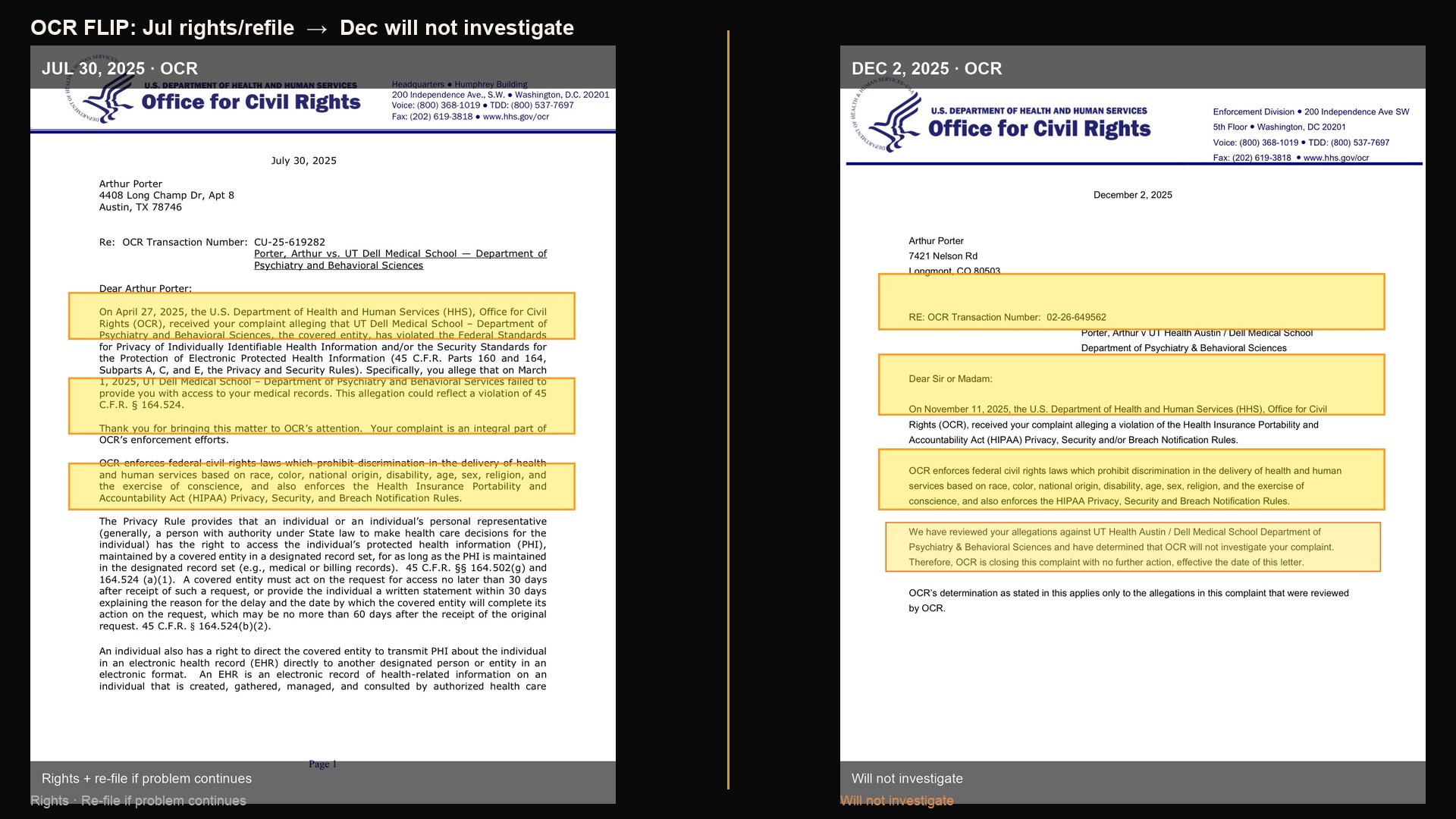
OCR stated rights language and enforcement rhetoric. On this file, the closeout included
“will not investigate.” Rights on paper. Null deed in practice. The underlying Dell/UTHA
access and coercion record did not vanish because a federal path closed.
Same grammar as soft family language that never engages the content: process that ends the conversation
without answering the evidence.
After chapters 1–7, the pattern should be visceral: care language without engagement; side channels;
permanent stamps under coercion; closeouts that declare peace while the file still burns.
That grammar scales. Party brands of Constitution and oversight while tribe and personality win the day.
Texas senators still hold phones. National figures still choose deeds over words.
Grassley irony (public record): anti-fraud / whistleblower brand set against soft landings
for power and hearing postures that protect the tribe. When the brand is “whistleblowers” and the deed is
“not this one,” that is “I hear you” without hearing — at Senate scale.
This site and the film are a promise to the record, not a threat. Officials write the plot
with every choice. Davy Crockett refused to be any man’s dog.