Documenting institutional harm at the University of Texas
When a public medical school writes lies into a permanent record
An evaluation under pressure. Labs minimized. Scores rewritten. A permanent medical stamp. Then institutional silence.
This site documents how Dell Medical School at the University of Texas at Austin conducted a psychiatric / neuropsychological evaluation under conditions of documented financial pressure on consent, produced a clinically and factually damaging permanent report, and was met with a wall of institutional non-response — while public messaging still claims cutting-edge, compassionate, whole-person care. The aim is an accurate public record and institutional accountability — not to humiliate anyone who loves this patient.
Arthur “Brent” Porter · Texas · UT Austin CS 1987 · Independent · last president voted for was G.W. Bush.
Why this site exists
December 2024 — evaluation under coercion, report that does not hold
In December 2024, Dell Medical School at the University of Texas at Austin conducted a neuropsychological evaluation under conditions of documented financial coercion. The resulting clinical report contained statements that are demonstrably false, professionally damaging, and directly contradicted by the evaluating institution’s own published research and by contemporaneous emails and labs.
The patient — a UT Austin alumnus (Class of 1987, B.S. Computer Science) whose own test results during this evaluation placed him in the 97th percentile — has been battling Lyme disease and related infections for 19 years while on disability. Dell Medical School’s report did not help him. It made him sicker. And the stress biology their own leadership is known for studying explains why coercion and dismissal are not footnotes.
This website presents the documented evidence across eight chapters. Every major claim is supported by verifiable documentation: emails, lab results, published research, and the evaluation report’s own internal contradictions. Formal complaints have been filed with the Texas Medical Board, the HHS Office of Inspector General, the HHS Office for Civil Rights, and SACSCOC.
The context
Why was this evaluation arranged?
[Sync: March 17, 2025 · Cuba, NM]
An AI-generated podcast summarizing the coercive timeline and OCR denial.
After 17+ years of battling Lyme disease and related infections, the patient began researching the mind-body connection — peer-reviewed science showing that childhood adversity and chronic stress (including family stress under long illness) can contribute to immune dysfunction and prolonged illness. He shared this research with family, including Bessel van der Kolk’s The Body Keeps the Score and Gabor Maté’s The Myth of Normal — leaving a copy of Maté’s book at a family home during a visit. The book was not taken up as a shared project.
That conversation is hard for any household. Science about stress and family systems can land as care — or as blame — even when the speaker intends the former. Here, the mind-body framing was largely received as personal criticism rather than a research-informed hypothesis. The patient had also repeatedly asked for nervous-system-calming recovery approaches; those asks did not become the shared plan.
In that strained context — with everyone under years of illness load — a path to Dell Medical School was arranged, including use of a personal connection to the Dell Medical Advisory Board. Support for the patient was then conditioned in writing-adjacent and contemporaneous terms on attending: evaluation as the gate to continued financial and medical support. Whatever the intent (help, clarity, safety, control, fear), that structure is what ethics calls pressure on consent. Dell accepted the case under those conditions and produced a permanent report.
What the process showed — without writing anyone out of the family
The coercion itself was real-time evidence of the very dynamic the patient’s research described. A family that responds to peer-reviewed science about stress and illness by creating more stress and coercion is demonstrating — not refuting — the pattern. Dell Medical School’s psychiatrists were trained to recognize this. They chose not to. The permanent report then locked the narrative.
A household under long medical stress can create more pressure while trying to “fix” things. That is a systems pattern, not a cartoon villain story. The patient had been pointing at stress biology; the path that followed added evaluation load, side-channel clinical logistics, and a lasting stamp. Clinicians trained to see stress and consent dynamics had a duty to pause and protect voluntary process. They did not. The permanent report locked a narrative the emails and labs still contradict.
Point by point
What Dell Medical School promises — and what they did
Read straight down. First their public words. Then what the record shows they did. No columns to choose between.
Summary: They sell whole-person, compassionate, evidence-based care.
1 · What their website says
Dell Medical School promises “cutting-edge” behavioral health care that treats “the whole person” with “compassion” and “the latest evidence-based approaches.”
Their public messaging emphasizes patient-centered care, integrative treatment, and a commitment to the mind-body connection in mental health.
Summary: Dell ran an evaluation under pressure on consent, minimized labs, rewrote Superior scores, took collateral input the patient was not fully party to, and locked it in a permanent record.
2 · What they actually did
- Consent. Conducted a psychiatric evaluation while the patient’s participation was under documented financial pressure (attend or lose support) — conditions APA ethics treat as incompatible with free, voluntary consent.
- Labs. Dismissed or minimized objective laboratory evidence of active tick-borne infections in a patient with 19 years of documented illness and disability.
- Scores. Downgraded 97th-percentile cognitive scores from the standardized “Superior” classification toward “above average” language that better fit a predetermined narrative.
- Collateral. Received family input outside a fully transparent, co-equal process with the patient — then later left that path hard to reconcile with what the chart admits.
- Record. Committed the result to a permanent medical record — under stress-biology knowledge their own institutional tradition studies — where process pressure is not a footnote.
Federal paper · same grammar
OCR: rights language — then “will not investigate”
After you know what Dell did, read the federal closeout the same way: first what they said about rights, then what they did on this file. Full image below — pinch-zoom or open full size.
Summary A: Your complaint is part of OCR’s enforcement story.
“Your complaint is an integral part of OCR’s enforcement efforts.”
Summary B: On this file — will not investigate. Closed. No further action.
“We have reviewed your allegations against UT Health Austin / Dell Medical School Department of Psychiatry & Behavioral Sciences and have determined that OCR will not investigate your complaint. Therefore, OCR is closing this complaint with no further action, effective the date of this letter.”
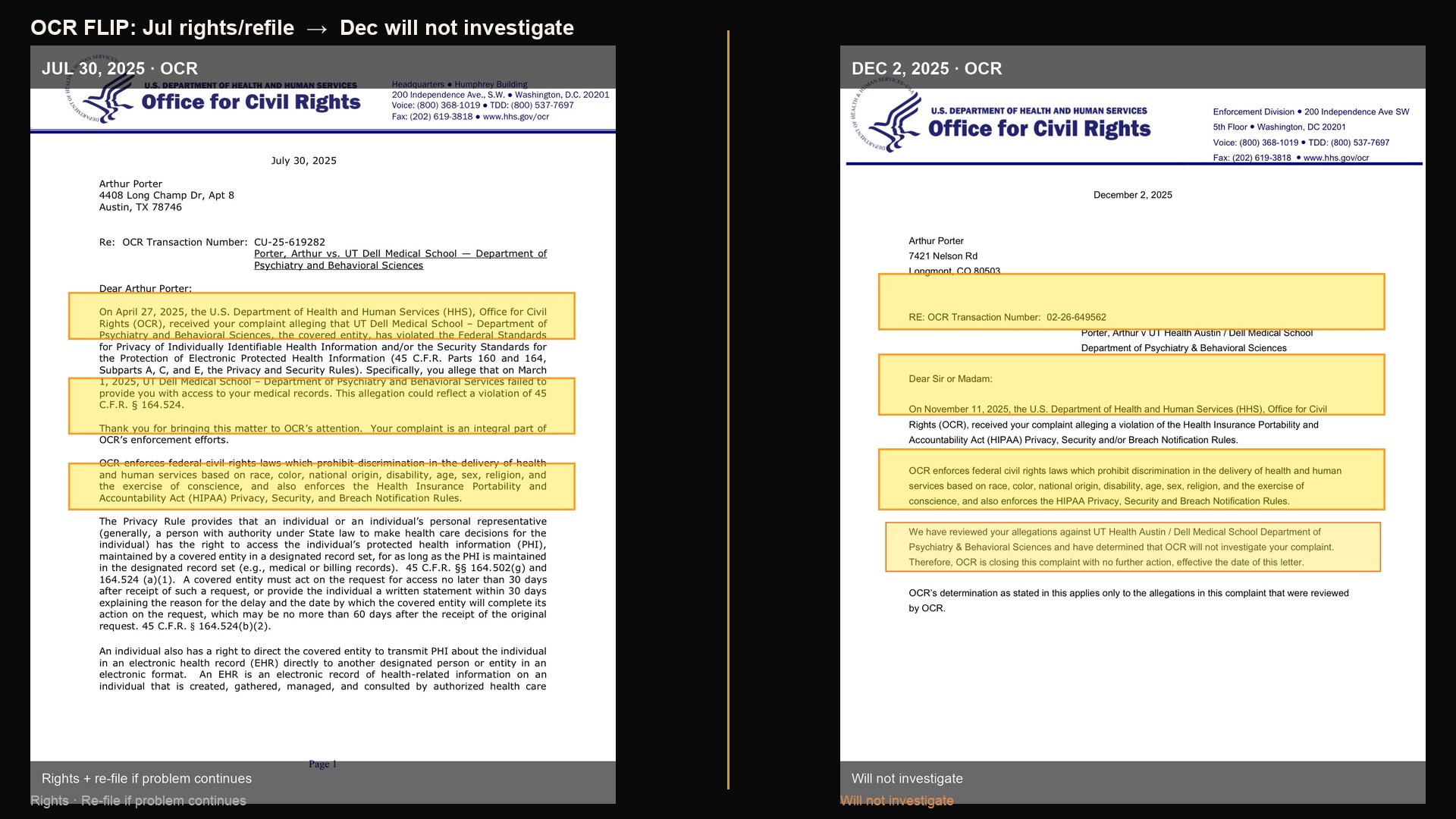
More on this closeout: OCR briefing page + video · Chapter 7 in the eight-chapter path.
The evidence path
Eight chapters — read in order
Full narrative path — then primary exhibits (emails, videos, OCR still). Open the chapter book first.
-
01
The foundation of truth
Consent void under financial coercion. Everything after rests on that crack.
-
02
The sincere request
467 chronological emails — Mom, Dad, Sister, BIL, Dell. Scroll if you doubt the volume.
-
03
The backdoor deal
Side-channel family–admin email while the patient was speaking hard truths mid-evaluation.
-
04
The financial ultimatum
Attend or lose support. Involuntary / coerced consent — the accurate ethics spine.
-
05
The shadow record
What the permanent report did with scores, labs, and narrative under pressure.
-
06
Harm of the process
Body under load — spasms, recovery, stress biology. Labeled fact vs inference.
-
07
The wall of silence
OCR rights language, then “will not investigate.” Short video + visual exhibit.
-
08
If they did this to me — and to the republic
Same grammar: private table → public square. Oversight, party loyalty, Grassley irony.
After you feel the outrage — the larger pattern
Dell’s grammar is not only clinical. It is institutional and national.
Read chapters 1–7 first as what was done to one patient under a permanent record. Then notice the same moves at scale: care language without engagement; process that never answers the content; side channels that route around the speaker; closeouts that declare the matter closed while the exhibits remain.
- Home. Care language that never quite meets the substance of what was asked — a pattern many families know under stress (see Dec 18 chronology: hearing reframed as “not everybody will agree”). Pattern, not a verdict on love.
- Clinic. Pressure on consent visible in the record’s own terms, then scores and labs bent toward a story that protects the path that was forced.
- Federal. Rights language, then will not investigate — a null deed after paper rights.
- Oversight. Constitution language on stage; tribe and personality first in practice. Texas senators and national leaders still hold levers. Deeds over words.
- Grassley. Anti-fraud / whistleblower brand set against soft landings for power and hearing postures that protect the tribe (public record: congratulations on nominations; dynamics around clemency / DOJ figures). Brand of whistleblowers + soft-landing power = “I hear you” without hearing — at Senate scale.
- Gatekeep. Who sits as Attorney General shapes which cases ever get oxygen — the same way a permanent clinical stamp shapes which life a patient is allowed to lead.
This is not “both sides.” It is pattern recognition: performance of care or republic over the hard duties of either. Davy Crockett refused to be any man’s dog. The film and this file are a promise to the record — not a threat. Officials write the plot with every choice.
Phones (DC): Cornyn (202) 224-2934 · Cruz (202) 224-5922
After the file — optional media
Song, briefing video, body under load
Home is evidence and narrative first. Media is here so emotion does not outrun the exhibits.
~5 min · original · play after you’ve read what Dell did
Rights language, then closeout. Full page with quotes: texas-briefing.html
Also on harm of process with recovery and context.
NotebookLM · radio-style.
A short “talk show” or podcast pass over this case — after the written exhibits —
can reach people who won’t scroll eight chapters. Drop a public-safe MP3 into
media/ (e.g. notebooklm-case-brief.mp3)
and we wire it here like the song. Keep it after the file so outrage stays grounded in documents.
Support this work. Optional gift for documentation and production — not a product purchase, not tax-deductible. Suggested floor $5 (or more). Stripe checkout uses a fixed unit price; quantity multiplies it, or you can set “customers choose amount” in the Dashboard (min $5). You cannot set $0 as a paid link — free is “close the tab.”
Support · from $5 →